The Swedish general election of 13 September 2026
Sweden elected 349 members of the Riksdag on 13 September. The Social Democrats, the Left Party, the Centre Party and the Greens took 176 seats to 173, and Ulf Kristersson resigned as prime minister on 17 September. The four percent threshold kept nobody out: all eight parties cleared it, the Liberals by 1.3 points.
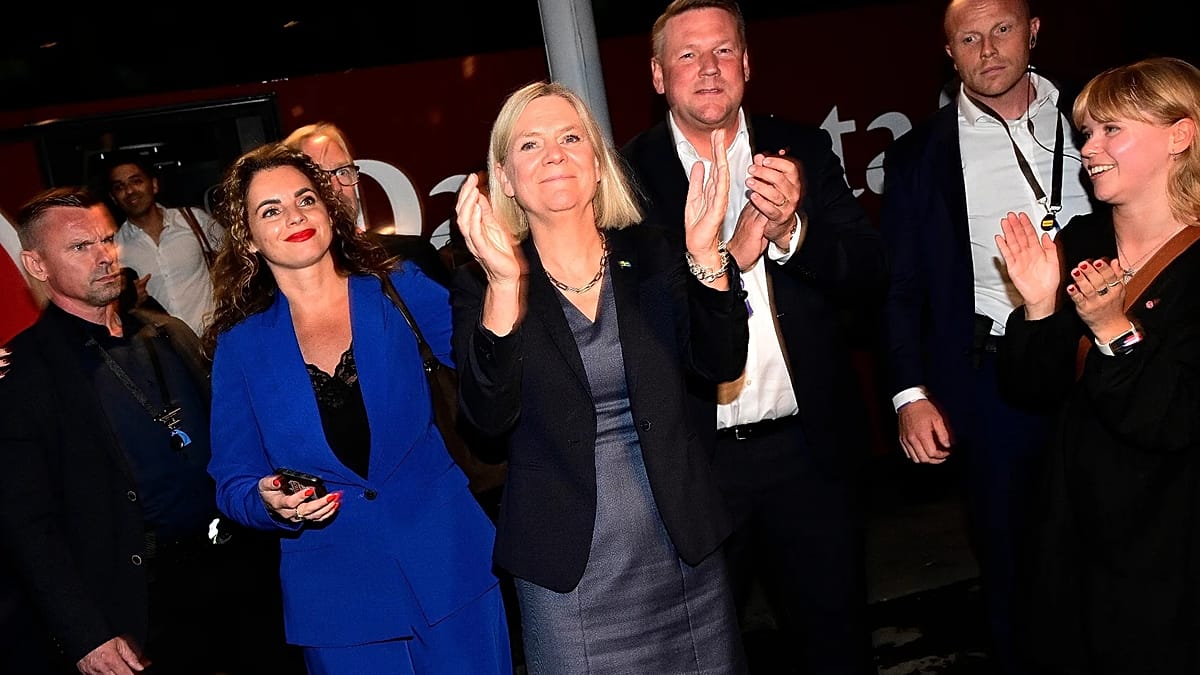
Sweden voted on 13 September for the Riksdag, for 21 regional assemblies and for 290 municipal ones. The Riksdag's 349 seats are shared out in proportion to votes, but only among parties that win four percent nationally or twelve percent in one constituency. The threshold is why seats can move further than votes. Ulf Kristersson had governed since 2022 with the Moderates, the Christian Democrats and the Liberals, kept in office from outside by the Sweden Democrats. Those four are the Tidö parties.
The Liberals spent the year below the threshold and finished above it. Statistics Sweden put them at 2.5 percent in May, Novus at 2.2 in June and Verian at 1.9 for SVT in August. On any of those figures they would have taken no seats. Novus had them above four percent for the first time on 7 September, and at 5.8 on 9 September. The institute's last barometer before the vote showed the party slipping back. They finished on 5.3 percent and 19 seats, three more than in 2022.
The blocs converged as the Liberals rose. Novus had the opposition 9.6 points ahead in June and 2.6 ahead on 1 September; Verian put it at 10 points in August. In the preliminary result the difference was 0.7 points, our sum of the parties' shares, and the news agency TT put the opposition's lead at 50,359 votes. The Tidö parties won in 2022 by 176 seats to 173, a margin Henrik Ekengren Oscarsson put at about 46,000 votes. This time the same 176 to 173 fell the other way.
The Sweden Democrats fell from 20.5 to 17.5 percent, their first drop in support since entering parliament in 2010. The Social Democrats held first place on 28.0 percent, which Al Jazeera called one of their worst in more than 100 years. Magdalena Andersson had campaigned on a safer, richer and more cohesive Sweden, attacking the government over unemployment, bankruptcies and hospital queues. The Sweden Democrat Richard Jomshof called her a quisling. Both big parties promised to scrap what they call the mängdrabatt; the Riksdag passed the change on 13 August.
Some overseas ballots are counted only on the Wednesday after election day, and that count moved a single seat: the Left Party gained one and the Social Democrats lost one, both inside the winning bloc. The 176 to 173 split therefore stood from election night. The roll held 226,906 Swedes abroad, against more than 182,000 eligible in 2022. The Election Authority finished the preliminary count on 17 September and put turnout at 84.8 percent, against 84.21 in 2022. It usually settles the final result about a week after election day, and by 18 September it had not done so. Kristersson resigned on 17 September and on 18 September was leading a caretaker government until a new one takes office. The new Riksdag meets on 28 September.
”But the opposition parties have a clear advantage over a future Tidö government, especially once you count in a Liberal party that is extremely low, 2.6 points below the four percent threshold.”
The numbers
What the comparison shows
Where they agree
Knutson and Sjöström started from the same place: the opposition led, and it was Kristersson who had to close the gap. He closed almost all of it, from about ten points in the summer polls to 0.7 in the count, and lost by three seats.
Where they split
Kristersson argued that support for the right would grow once the election became a real choice between two alternatives. Knutson wrote that the campaign might already be decided unless the Tidö parties pulled off a historic recovery. The gap between the blocs went from 10 points in Verian's August reading to 0.7 in the count, and the Tidö parties still lost. Nobody settled the other argument, the one about the overseas vote: Oscarsson expected 70,000 to 80,000 votes from abroad and thought first-time voters mattered more, and no source here breaks the result down by either group.
What nobody is saying
Who will govern, and with whom. Kristersson leads a caretaker government and the new Riksdag meets on 28 September, but no source here names a cabinet or a coalition. Two of the four parties that now hold the majority, the Left Party and the Greens, opposed NATO membership and neither seeks withdrawal, and nothing here says what the four would do together in foreign policy. The sentencing reform passed in August has no start date either: the amendments enter into force on the day the government decides.
Who says what
Andersson tied her campaign to a world she called more dangerous and unpredictable than it had been in a long time, and gathered her policy into three promises: a safer, richer and more cohesive Sweden. In practice that meant stronger defence, more police and a Swedish mafia law, higher child benefit, an end to the first unpaid day of sick leave, a stop to profit-taking from free schools, and everyone learning Swedish. She avoided naming the Left Party and the Greens as partners.
Kristersson played down the opposition's lead in the polls and argued that support for the right would grow once voters saw what the two blocs stood for on tax, crime and migration. He called Richard Jomshof's quisling accusations distasteful and indecent in an interview with Aftonbladet, and aimed his criticism at both Jomshof and the newspaper.
”Så säger man bara inte. Man kan ha en tuff politisk debatt och diskussion även om svåra saker. Men man måste kunna skilja på sak och person, det gäller ärligt talat både Jomshof och Aftonbladet.”You simply do not say that. You can have a tough political debate and discussion, even about difficult things. But you have to be able to separate the issue from the person, and frankly that goes for both Jomshof and Aftonbladet.
Jomshof called Aftonbladet's political editor Anders Lindberg a quisling on X, hours after Lindberg posted a video saying Jomshof could become justice minister in a Moderate-led government with Sweden Democrat ministers. He defended the word by pointing out that Lindberg himself had likened the prime minister to Franz von Papen, the German conservative who, as SVT puts it, played a decisive role in Hitler's rise to power. Shortly afterwards he called Magdalena Andersson a quisling too. Lindberg replied that opinion journalism is not treason, and Kristersson, Ebba Busch and Simona Mohamsson all criticised the tone.
”De kryper ju alla för islamisterna, vars mål är att ta vår demokrati och vårt land ifrån oss”They all crawl for the islamists, whose goal is to take our democracy and our country away from us
Knutson read the position as asymmetric. Kristersson needed a game changer, an event or announcement that would turn opinion quickly, while Andersson gained most by taking no risks. He also noted that the Tidö parties' budget spending had produced no result so far, and that they were pinning their hopes on undecided voters, up to 15 to 20 percent of the electorate in early-summer polling.
”En valrörelse som redan kan vara avgjord om inte Tidöpartierna presterar en historisk upphämtning under de 41 dagar som återstår till valdagen.”A campaign that may already be decided unless the Tidö parties pull off a historic recovery in the 41 days left until election day.
Sjöström put the decision in the threshold rather than in the gap between the blocs. In his analysis of the July barometer he wrote that the Liberals were lower than at any earlier reading in Novus's history, that is since 2006, and that the party picking up most of their voters was the Centre Party, which sits on the other side of the bloc line. He also argued that the old tactical-vote logic of the Alliance years was gone, so the small parties had to show they were needed in their own right.
”Men oppositionspartierna har ett klart övertag över en framtida Tidöregering, särskilt om man räknar in ett L som ligger extremt lågt, 2,6 procentenheter under 4-procentsspärren.”But the opposition parties have a clear advantage over a future Tidö government, especially once you count in a Liberal party that is extremely low, 2.6 points below the four percent threshold.
Oscarsson expected 70,000 to 80,000 votes from abroad and pointed out that first-time voters are many times more numerous. He called the 2022 election the third closest in Swedish democratic history, settled by about 46,000 votes, and said that only in a race that close could anyone point to the overseas votes as decisive, and elections are rarely that close. He described the group as very mixed, from tax exiles to students, and their ballots land in the same late pile as late-arriving early votes from within Sweden.
Our coverage
- Andersson formally tasked with forming government, given 28 daysSaturday, 19 September 2026
- Speaker begins government-formation talks as Sweden's coalition deadlock holdsFriday, 18 September 2026
- Sweden's left bloc edges ahead 176-173 as Andersson faces a fractious coalitionThursday, 17 September 2026
- EU delays tobacco and nicotine tax vote until after Sweden votesSaturday, 12 September 2026
- Sweden's PM pledges cabinet seats to Sweden Democrats, says he wants to 'make Sweden great again'Saturday, 12 September 2026
- Sweden logs 2,800 election incident reports as smaller parties cry fraudSaturday, 12 September 2026
- Kristersson and Andersson clash bitterly over sentencing discount days before electionFriday, 11 September 2026
- Sweden's Liberals pull further clear of the parliamentary thresholdThursday, 10 September 2026
- Sweden's election race narrows further to 2.4 points, 6 days from the voteTuesday, 8 September 2026
- Sweden's election race narrows to its tightest gap in three years, a week before the voteSunday, 6 September 2026
- Sweden's election turns into a nail-biter eight days out, and Busch rejects Akesson's cross-bloc suggestionSaturday, 5 September 2026
- Eight days before Sweden's September 13 election, a security question splits even the governing coalitionSaturday, 5 September 2026
- Kristersson rejects Sweden Democrats' demand for twelve cabinet postsFriday, 4 September 2026
- Swedish opposition's lead collapses to 2.6 points ahead of the voteThursday, 3 September 2026
- Social Democrats campaign on the dental reform of the centuryWednesday, 2 September 2026
- A 'fika' doesn't settle Sweden's right-wing bloc rift, two weeks before the electionTuesday, 1 September 2026
- Åkesson opens final campaign push as Sweden Democrats lose ground in the pollsSunday, 30 August 2026
- Record turnout as early voting opens ahead of Sweden's September 13 electionSaturday, 29 August 2026
- Andersson: Sweden Democrats drove Moderates to “economic-political disaster” ahead of 13 September electionFriday, 28 August 2026
- Opposition narrows gap on governing right-wing bloc three weeks before Swedish electionThursday, 27 August 2026
- Busch rejects Åkesson's ultimatum on the LiberalsWednesday, 26 August 2026
- Government to set up school attack commission three weeks before electionTuesday, 25 August 2026
- Estonia warns of rising Russian influence risk as Sweden's election nearsMonday, 24 August 2026
- Åkesson signals Sweden Democrats won't fight to keep Liberals' seats in parliamentMonday, 24 August 2026
- Two men arrested over suspected plot to assault Sweden's justice ministerSunday, 23 August 2026
- Early voting opens 26 August as Sweden's opposition narrows the gapSaturday, 22 August 2026
- Centre Party bets on a Tidö collapse, three weeks before the voteFriday, 21 August 2026
- Åkesson aims for the prime minister's job in 2030, before the 13 September electionThursday, 20 August 2026
- Swedish opposition holds ten-point lead a month before electionWednesday, 19 August 2026
- Party leaders clash over household finances in election debateWednesday, 19 August 2026
- Digital voting cards go out for the first time ahead of the electionTuesday, 18 August 2026
- Mohamsson plays down the gap with the Sweden Democrats on integration: "it is about governance"Monday, 17 August 2026
- The Tidö parties set up a waste commission to go through state spendingMonday, 17 August 2026
- The Moderates and the Social Democrats both promise to stop borrowing next termSunday, 16 August 2026
- The Tidö parties set up a waste commissionSaturday, 15 August 2026
- The Centre leader attacks the jobs policy of the bloc she means to govern withSaturday, 15 August 2026
- The Riksdag lowers the age of criminal responsibility to 14Friday, 14 August 2026
- The opposition's lead halves to 3.7 points a month before the electionFriday, 14 August 2026
- The opposition attacks the tighter family reunion rules in a special sittingThursday, 13 August 2026
- Andersson promises transitional rules for citizenship applicationsThursday, 13 August 2026
- Åkesson would spend exactly zero on integration programmesWednesday, 12 August 2026
- Kristersson has not decided whether to extend the crisis tax cutsTuesday, 11 August 2026
- Teen deportations were far more widespread than reportedTuesday, 11 August 2026
- The Social Democrats would scrap the bulk discount on sentences, starting with sexual offencesSunday, 9 August 2026
- The Sweden Democrats' migration spokesman dismisses the worry among skilled labour migrantsSunday, 9 August 2026
- Moderates say 70 billion kronor in savings will pay for their election promisesSaturday, 8 August 2026
- Swedish inflation falls to 0.7 percent, but tax cuts are carrying the declineFriday, 7 August 2026
- Sweden's election campaign starts in earnest as both prime ministerial candidates take to the roadMonday, 3 August 2026
- Sweden Democrat Richard Jomshof likens Aftonbladet's political editor to QuislingMonday, 3 August 2026
- Andersson and Kristersson launch their election tours with 41 days to goSunday, 2 August 2026
- Voting from abroad has opened for the Swedish election, but its weight is disputedSaturday, 1 August 2026
- Swedes abroad are the first to vote in the parliamentary electionThursday, 30 July 2026