The Strait of Hormuz
The strait carries oil equal to about a fifth of world petroleum liquids consumption and about a fifth of traded liquefied natural gas, and on EIA's June 2025 estimate the pipelines around it hold only some 2.6 million barrels a day of spare capacity, which makes control of passage a lever long before the strait is fully closed.
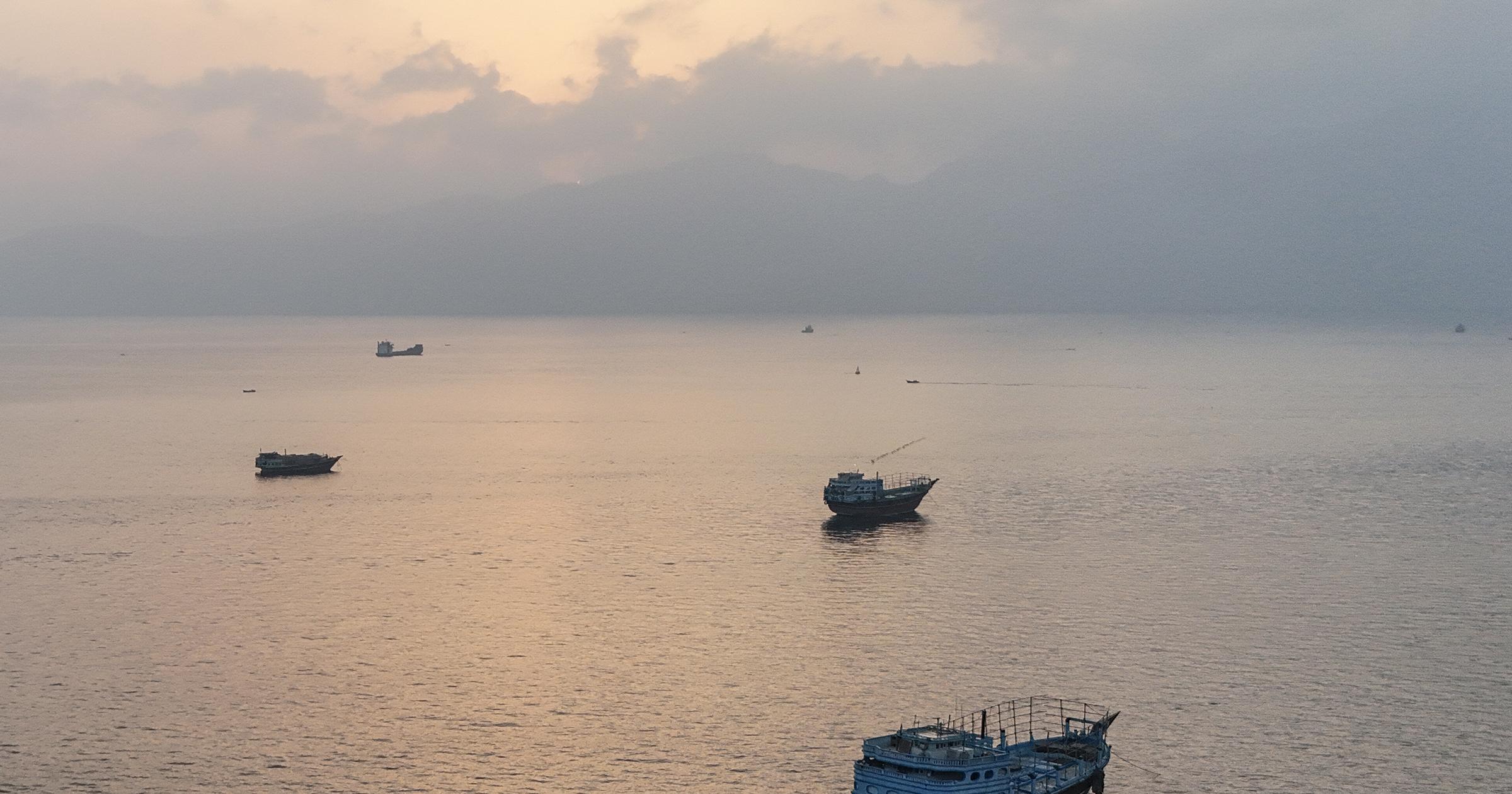
The Strait of Hormuz is the sea passage between Iran and Oman that connects the Persian Gulf to the Gulf of Oman and the Arabian Sea. At its narrowest it is about 33 kilometres across. The US Energy Information Administration puts average oil flows through it at about 20 million barrels a day in 2024, roughly a fifth of world consumption of petroleum liquids. Around a fifth of globally traded liquefied natural gas took the same route that year, most of it from Qatar.
The US-Israel war on Iran began on 28 February 2026, and Iran restricted passage to most ships from early March, in what Al Jazeera called an effective closure. A memorandum of understanding with Washington reopened it on 17 June, on condition that Iran keep the strait open for 60 days. It fell apart in July, Al Jazeera reports, over which routes ships should take. Ships now avoid the pre-war channels for fear of naval mines, using two corridors, one in Iranian waters and one in Omani waters under US oversight.
EIA tanker-tracking estimates for 2024 put Saudi Arabian crude and product flows through the strait at about 5.5 million barrels a day, Iraq's at 3.2 million, the United Arab Emirates' at 1.9 million and Kuwait's at 1.3 million. Of the crude and condensate, 84 percent went to Asian buyers, and China, India, Japan and South Korea took 69 percent between them. Europe took about 0.7 million barrels a day of the crude.
Almost none of that oil has another way out. EIA said in June 2025 that only Saudi Arabia and the UAE have pipelines round the strait, Aramco's East-West line to Yanbu at 5 million barrels a day and a 1.8 million barrel line to Fujairah. Neither runs full, and EIA put the capacity available in a disruption at about 2.6 million barrels a day. Ankara and Baghdad renewed the Kirkuk to Ceyhan pipeline on 1 August 2026 at 750,000 barrels a day, against actual flows near 170,000 on Turkish data.
The Law of the Sea Convention says transit passage through an international strait shall not be impeded and shall not be suspended. Articles 38 and 44 say nothing about charging for it. Al Jazeera writes that maritime law bars tolls for passage itself but lets a coastal state charge for services such as pilotage. Iran wants recognised control of its own side and a fee system for ships, and said in early August 2026 that it will not reopen the strait until Washington lifts its naval blockade of Iranian ports.
”The Omanis are now suggesting three lines for the maritime traffic: one that runs through Iran's territorial waters, an international one, and one through Omani territorial waters”
The numbers
What the comparison shows
Where they agree
The strait carries oil equal to about a fifth of world petroleum liquids consumption and about a fifth of traded liquefied natural gas, and there is no substitute route on that scale: EIA puts spare pipeline capacity at about 2.6 million barrels a day against roughly 20 million that normally transits. The head of Middle East and North Africa country risk at S&P Global says the damage starts well before a full closure, because making passage conditional on permission is already enough to load costs and uncertainty onto shipping.
Where they split
Iran and Washington disagree first about money and control. Iran has signalled that it plans some form of fee system for ships. Washington wants freedom of navigation with no Iranian tolls and no requirement that ships obtain Tehran's approval before transiting. Reuters reported on 28 July 2026 that Oman had put a middle course to Iran, a joint regional mechanism with voluntary fees on the Strait of Malacca model. Ankara and Baghdad present the renewed Kirkuk to Ceyhan pipeline as a strategic alternative to the strait; Turkish data put its flow at about 170,000 barrels a day on 1 August 2026, and it sits outside EIA's spare-capacity estimate, which covers the Saudi and Emirati lines only.
What nobody is saying
Al Jazeera reported on 28 July 2026 that mine clearance would be Iran's responsibility. That report does not say when clearance happens, who verifies that a lane is clear, or what follows if verification never comes. On Al Jazeera's account of 9 July the central part of the strait, where the seabed is believed to be most mined, was largely unused. No price for war-risk cover on a Hormuz transit is public either: Al Jazeera reported on 1 May that insurance and war-risk premiums were rising, and gave no figure for the strait.
Who says what
A deal with Oman does not mean the strait opens. He said on 8 August 2026 that talks with Oman were approaching their final stages, while cautioning that this was not a sign of reopening.
”The reopening of the Strait of Hormuz is subject to other conditions and compensation for the violation of the memorandum of understanding by the United States”The reopening of the Strait of Hormuz is subject to other conditions and compensation for the violation of the memorandum of understanding by the United States
The strait cannot return to its pre-war state of free-flowing shipping. He rejects an Omani proposal for an equal division of the transit routes between the two countries, saying it does not address Iran's security concerns, and proposes instead that Iran manage shipping on its own side while Muscat manages part but not all of the opposite lane. Iran, he says, will consider any action to keep control, including a resumption of the war.
Reports what the Omanis are offering now: three separate lanes, not the two-way division of the routes that Iran rejected the same day. His sources tell him Iran is showing some flexibility despite its public statements.
”The Omanis are now suggesting three lines for the maritime traffic: one that runs through Iran’s territorial waters, an international one, and one through Omani territorial waters”The Omanis are now suggesting three lines for the maritime traffic: one that runs through Iran's territorial waters, an international one, and one through Omani territorial waters
The damage does not begin at closure. Making passage conditional on permission is enough to load costs and uncertainty onto shipping, and the danger is the precedent: if several states test the boundaries with selective enforcement, tolls or levies in international straits, outcomes are settled by bargaining power.
”Even short of a full shutdown, ‘permissioning’ and pressure can impose major costs and uncertainty”Even short of a full shutdown, 'permissioning' and pressure can impose major costs and uncertainty
Treats maritime pressure as an old instrument now used on a far larger merchant fleet.
”Maritime action has always been an important aspect to weigh pressure on an enemy’s economy and military – there is nothing new there, but what has changed is the scale, the volume of containers, the size of the global fleet”Maritime action has always been an important aspect to weigh pressure on an enemy's economy and military, there is nothing new there, but what has changed is the scale, the volume of containers, the size of the global fleet
The transit arrangement on the Kirkuk to Ceyhan pipeline is back in force. He announced on 1 August 2026, after a meeting in Ankara with Iraq's oil minister, that an arrangement covering a daily capacity of 750,000 barrels had been implemented, while talks on a long-term agreement continue.
Flows through the strait made up more than a quarter of all global seaborne oil trade in 2024 and the first quarter of 2025.
”Most volumes that transit the strait have no alternative means of exiting the region, although there are some pipeline alternatives that can avoid the Strait of Hormuz.”Most volumes that transit the strait have no alternative means of exiting the region, although there are some pipeline alternatives that can avoid the Strait of Hormuz.
Our coverage
- US commander says Hormuz shipments hit six-month high, claims Iran has exported zero barrelsSunday, 20 September 2026
- Trump nears 'big decision' on Iran as tanker war escalates in HormuzFriday, 18 September 2026
- US claims on Hormuz oil flow undercut by ship-tracking data as oil tops $107Thursday, 17 September 2026
- Bahrain refuses to join Iran-proposed talks on Hormuz shippingSaturday, 12 September 2026
- Iran claims new wave of Hormuz ship attacks; US denies any vessel hitFriday, 11 September 2026
- Iran expands restricted maritime zone beyond Hormuz after it says it struck vesselsThursday, 10 September 2026
- US and Iran keep striking each other's tankers as Hormuz shipping collapsesMonday, 7 September 2026
- US destroys one Iranian oil tanker and disables two others after Iran fires on US warshipsSunday, 6 September 2026
- Oil rallies on Hormuz risk as OPEC+ prepares to hold output steadyFriday, 4 September 2026
- Iran strikes US bases in Iraq, Jordan and Gulf states after wedding deathsThursday, 3 September 2026
- US strikes Iran again, Tehran says an attack hit a weddingWednesday, 2 September 2026
- Trump vows to 'hit hard' after first US-Iran exchange of fire in a monthTuesday, 1 September 2026
- US fires on Iran's Larak Island, IRGC says it fired on US bases in JordanMonday, 31 August 2026
- Iran's oil exports collapse as US naval blockade of Hormuz tightensSaturday, 29 August 2026
- Iran says it is preparing conditions for reopening the Strait of HormuzFriday, 28 August 2026
- Iran and Oman agree phased framework for temporary Hormuz corridorWednesday, 26 August 2026
- Iran's Pezeshkian defends US memorandum as deadlock persists over HormuzMonday, 24 August 2026
- NATO's top commander in Europe convenes allies on the Strait of Hormuz, stops short of a missionSunday, 23 August 2026
- The United Arab Emirates stops all trade and all payments with IranThursday, 20 August 2026
- Trump denies Iran talks as Hormuz standoff continuesWednesday, 19 August 2026
- The memorandum between the United States and Iran has expired with no dealTuesday, 18 August 2026
- The memorandum between the United States and Iran expires today with no sign of an extensionMonday, 17 August 2026
- The White House says Trump was joking about Hormuz, Tehran replies that the strait stays IranianSunday, 16 August 2026
- Trump says he will soon declare the Strait of Hormuz United States territorySaturday, 15 August 2026
- The Emirates accuse Iran of attacking two ADNOC vessels in HormuzFriday, 14 August 2026
- Trump says the US controls Hormuz completely, Iran says the strait is closedThursday, 13 August 2026
- Trump turns Iran's compensation demand back on Tehran as the Hormuz talks stallTuesday, 11 August 2026
- The Revolutionary Guards will not reopen Hormuz until every one of Tehran's conditions is metMonday, 10 August 2026
- The UAE says Iran hit one of its tankers as Tehran talks up an Oman dealSunday, 9 August 2026
- Iran says its deal with Oman on the Strait of Hormuz is close to finalFriday, 7 August 2026
- Oman-mediated talks on the Strait of Hormuz continue as Washington signals optimism and Tehran plays downWednesday, 5 August 2026
- Trump gives Iran a last chance and keeps the blockade of its southern portsMonday, 3 August 2026
- Ankara and Baghdad renew the Kirkuk pipeline for a year at 750,000 barrels a daySunday, 2 August 2026
- Trump calls off the attack on Iran, saying the perimeters of a deal are agreedSunday, 2 August 2026
- Türkiye and Iraq sign a one-year deal on the oil pipeline to CeyhanSaturday, 1 August 2026
- Iran says it struck US bases in Kuwait and Bahrain after a new wave of American attacksFriday, 31 July 2026
- US and Iran trade missile barrages as hopes of a quick end fadeThursday, 30 July 2026
- Iraq offers Turkey a million barrels of oil a day while the Strait of Hormuz stays closedWednesday, 29 July 2026
- US joins forces with Saudi Arabia to strike Tehran-backed militias in IraqWednesday, 29 July 2026
- Iran and Oman trade proposals on how the Strait of Hormuz should be runTuesday, 28 July 2026